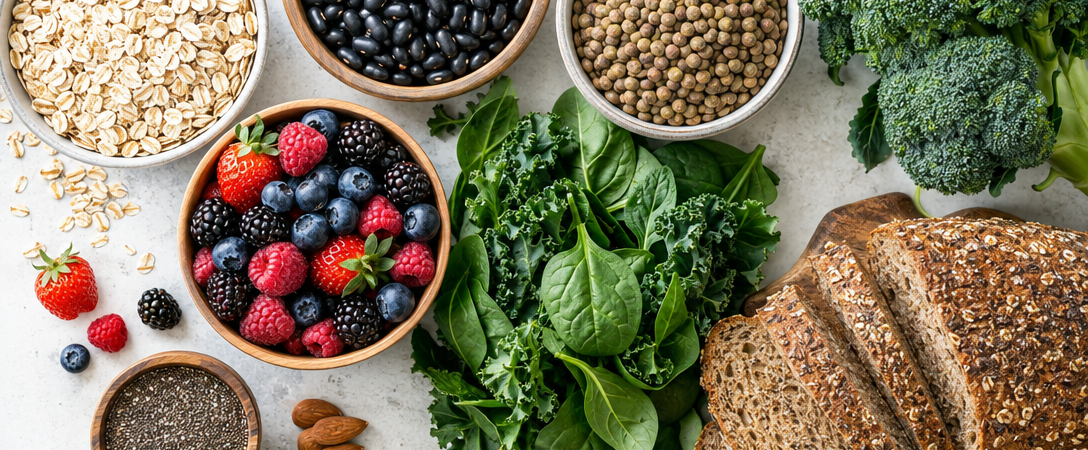
- Fibre is the nutrient lifters most often ignore, and it quietly affects hunger, digestion, and how good a diet feels to run.
- A sensible target for most active adults is roughly 25 to 38 g of fibre a day, scaled to how much you eat.
- Fibre keeps you full for very few calories, which makes both cutting and bulking far more comfortable.
- Ramp intake up gradually and drink enough water, or you will trade one gut problem for another.
- Whole foods beat fibre supplements for most people; use a supplement only to plug a genuine gap.
Working out how much fiber for lifters is enough comes down to a simple range: most active adults do well on roughly 25 to 38 g of fibre a day, scaled to total intake. Fibre matters because it controls hunger, keeps digestion regular, and feeds a healthy gut, all of which make a high-protein training diet easier to stick to. It is the least glamorous nutrient a lifter tracks, and one of the most useful once you get it right.
What fibre actually does for a lifter
Fibre is the part of plant food you do not fully digest, and that is exactly why it helps. It slows the passage of food, which steadies blood sugar and blunts hunger between meals. It adds bulk in the gut, which keeps you regular, a real issue when you suddenly load up on protein and cut back on the convenience foods that used to keep things moving. It also feeds the bacteria in your gut, which is increasingly linked to overall health.
For someone chasing a physique goal, the standout benefit is fullness. Fibre-rich foods take up space and take time to eat, so you feel satisfied on fewer calories. That helps enormously when you are dieting, and it stops a bulk turning into a miserable, bloated grind. Fibre sits inside your carbohydrate intake, so it pairs naturally with the ideas in our guide to macronutrients.
How much you actually need
General guidance lands most active adults between 25 and 38 g a day, with larger people who eat more food sitting at the higher end. A rough rule of thumb some find useful is around 14 g per 1,000 calories eaten, which scales sensibly whether you are cutting or bulking.
| Phase | Rough daily intake | Fibre target |
|---|---|---|
| Aggressive cut | ~1,800 kcal | 25 g or so |
| Maintenance | ~2,500 kcal | 30 to 35 g |
| Building phase | ~3,200 kcal | 35 to 45 g |
There is such a thing as too much. Pushing well beyond these numbers, especially quickly, tends to cause bloating, gas, and discomfort, and very high fibre can interfere with appetite during a hard bulk when you need to eat a lot. More is not automatically better.
Where to get it
Whole foods are the easy answer, and they bring vitamins and minerals along for the ride. Good staples for lifters include:
- Oats and wholegrains for a steady breakfast base.
- Beans, lentils, and chickpeas, which also add plant protein.
- Berries, apples, and pears for fibre that satisfies a sweet craving.
- Broccoli, carrots, and leafy greens for high volume at very low calories.
- Potatoes with the skin on, a favourite carbohydrate that quietly adds fibre.
If you genuinely cannot hit your target from food, a supplement like psyllium husk can fill the gap, but treat it as a patch, not a foundation. Whole foods give you fullness, micronutrients, and fibre together, which a scoop of powder cannot match.
Two mistakes to avoid
The first is the sudden spike. Going from 10 g to 40 g overnight is a recipe for a very uncomfortable day. Add fibre gradually over a week or two so your gut adapts. The second is forgetting water: fibre pulls water into the gut and needs it to do its job, so higher fibre without more fluid can actually leave you constipated, the opposite of what you wanted. Drink to thirst and a little beyond, and the whole system runs smoothly. Our notes on hydration cover getting fluid right around training.
Fibre during a hard bulk
Very lean, high-fibre foods fill you up, which is a problem when you are trying to eat a big surplus. If you are struggling to hit calories, ease off the highest-volume vegetables slightly and lean on more calorie-dense carbohydrates. You still want enough fibre for regularity, just not so much that you cannot finish your meals.
Frequently asked questions
How much fiber should a lifter eat and why?
Most active adults do well on roughly 25 to 38 g of fibre a day, scaled up if you eat more food. Fibre matters because it controls hunger, steadies blood sugar, keeps digestion regular, and feeds a healthy gut. For lifters, the fullness it provides makes both cutting and bulking far more comfortable to sustain over time.
Does fibre help with fat loss?
Indirectly, yes. Fibre itself is not a fat burner, but fibre-rich foods are filling for very few calories, so they make a calorie deficit much easier to hold. Feeling satisfied on less food is a genuine advantage when dieting. The fat loss still comes from the deficit; fibre simply helps you stay in it without constant hunger.
Should I take a fibre supplement?
Only if you cannot reach your target from whole foods. Supplements like psyllium husk work fine as a patch, but they lack the vitamins, minerals, and fullness that come with real food. Try to build your intake from oats, beans, fruit, and vegetables first, then use a supplement to close any remaining gap.
Why does more fibre make me bloated?
Usually because you increased it too fast or are not drinking enough water. Fibre ferments in the gut and pulls in water, so a sudden jump causes gas and bloating, and too little fluid can cause constipation. Raise your intake gradually over a week or two and drink plenty, and the discomfort typically settles down.
The bottom line
Fibre will not build your arms, but it makes the diet that does far easier to live with: fuller, more regular, and more comfortable. Aim for the mid-20s to high-30s in grams, get it mostly from whole foods, ramp up slowly, and drink your water. Zerxus keeps your training on track while your nutrition does its quiet work. Build your plan at Zerxus.
Get the next one in your inbox.
Practical insights — no fluff, straight to your inbox.
Zerxus Coaching Team
Certified Strength & Conditioning Coaches
The Zerxus coaching team combines qualified personal trainers, certified strength coaches, and evidence-based sports science to build programmes that actually work. Every article is grounded in peer-reviewed research and practical coaching experience — no fads, no shortcuts.