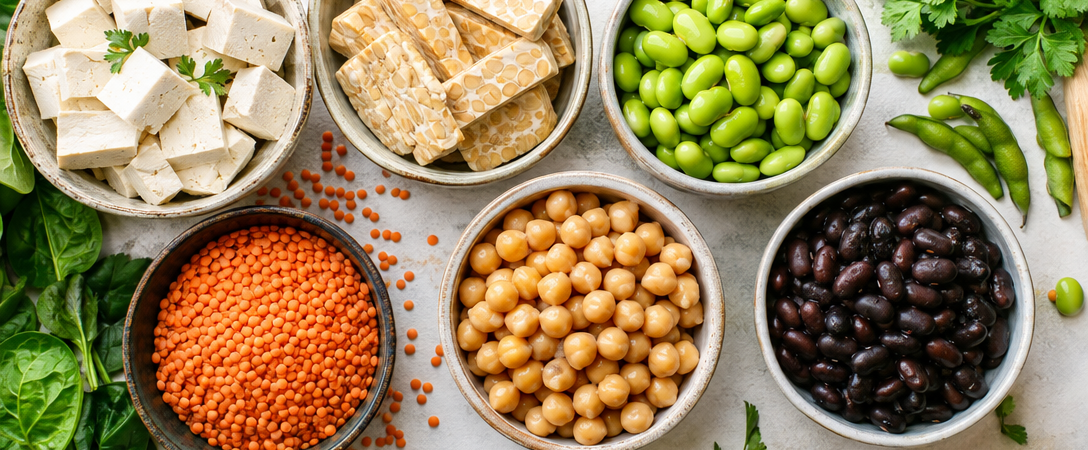
- Vegan muscle building absolutely works. You need enough total protein, enough calories, and hard training, just like anyone else.
- Plant proteins are lower in leucine and often incomplete, so aim a little higher on total protein and vary your sources.
- Lean on soya, seitan, legumes, and a plant protein powder to hit your numbers without a mountain of food.
- Watch a few nutrients that are harder to get from plants: vitamin B12, iron, omega-3s, and possibly creatine.
- The training rules do not change at all. Progressive overload builds the muscle; diet just supplies the materials.
You build muscle on a vegan or plant-based diet the same way anyone does: eat enough total protein, eat enough calories to grow, and train hard with progressive overload. Vegan muscle building works well, with two small adjustments, aim a little higher on total protein and vary your sources, because plant proteins are lower in the amino acid leucine and often lower in one or two essential amino acids. Beyond that, the principles are identical.
The protein question, answered honestly
Plant proteins carry a couple of quirks. Many are “incomplete”, meaning they are low in one or more essential amino acids, and most are lower in leucine, the amino acid that switches on the muscle-building signal at each meal. This does not make them useless; it makes variety and slightly higher totals the sensible response.
- Aim a touch higher on protein. Where an omnivore targets 1.6 to 2.2 g per kg, plant-based lifters do well nudging towards the upper end of that range.
- Vary your sources. Combining, say, grains and legumes across the day covers the full amino acid profile easily; you do not need to combine them at every single meal.
- Hit enough per meal. Slightly larger portions help reach the leucine threshold, in line with our protein guide.
The best plant protein sources
Some plant foods carry far more protein per calorie than others. Build your diet around the heavy hitters rather than trying to get all your protein from nuts and grains.
| Source | Why it earns a place |
|---|---|
| Soya (tofu, tempeh, edamame, soya milk) | Complete protein, high leucine, versatile |
| Seitan | Very high protein per calorie (low in lysine, so pair with legumes) |
| Legumes (lentils, beans, chickpeas) | Protein plus fibre and micronutrients |
| Plant protein powder (pea, soya, rice blends) | Easy way to top up without huge volume |
| Seeds and pseudo-grains (hemp, quinoa) | Useful supporting sources |
Soya deserves special mention: it is a complete protein with a good leucine content, and despite persistent internet fears, moderate soya intake does not harm testosterone or muscle in men. It is one of the most useful foods a plant-based lifter has. A protein powder makes hitting daily targets far easier, much like the convenience covered in our high-protein meals guide.
The nutrients to keep an eye on
A well-planned plant-based diet is healthy, but a few nutrients need attention because they are scarce or absent in plants.
- Vitamin B12. Essentially not present in plant foods; supplement it. This is non-negotiable on a fully vegan diet.
- Iron. Plant iron is less well absorbed; pair iron-rich foods with vitamin C and monitor if you feel run down.
- Omega-3s. Consider an algae-based supplement, since plant omega-3 converts poorly to the useful forms. Our supplements guide covers the sensible options.
- Creatine. Found almost entirely in meat, so vegans start with lower stores. A standard creatine supplement can noticeably help training; see our creatine guide.
None of these are dealbreakers. They are simply the boxes a plant-based lifter ticks that an omnivore ticks by default.
Myths that put people off
Let us retire a few. “You cannot build serious muscle without meat”, plainly false, plenty of strong, muscular people eat entirely plants. “Soya lowers testosterone”, not at moderate, normal intakes. “You must combine proteins at every meal”, no, covering your amino acids across the whole day is enough. The real requirements are unglamorous: enough protein, enough calories, and consistent hard training. Miss those and it will not work, meat or no meat. Nail them and plants are perfectly capable of building the physique you want.
Training does not change
This is worth repeating because people expect a special “vegan workout”. There is no such thing. Muscle is built by progressive overload, gradually doing more over time, regardless of diet. If anything, getting the training right matters more than any dietary tweak. Diet supplies the raw materials; training provides the instruction to build.
Frequently asked questions
How do you build muscle on a vegan or plant-based diet?
Eat enough total protein, aiming towards the upper end of 1.6 to 2.2 g per kg, from varied sources like soya, seitan, legumes, and a plant protein powder. Eat enough calories to grow, supplement vitamin B12 and consider creatine and omega-3s, and train hard with progressive overload. The core principles are identical to any diet; plants simply need a little more planning.
Do vegans need more protein to build muscle?
Slightly, yes. Plant proteins are lower in leucine and some are incomplete, so aiming a touch higher and varying sources ensures you get the full amino acid profile and enough of the muscle-building trigger. Targeting the upper end of the usual protein range, along with a few larger protein feedings, comfortably closes the small gap between plant and animal sources.
Is soya bad for testosterone or muscle?
No. Moderate soya intake does not lower testosterone or impair muscle growth in men; this is a persistent myth. Soya is actually one of the best foods for plant-based lifters, being a complete protein with a good leucine content. Tofu, tempeh, edamame, and soya milk are all excellent, versatile ways to hit your protein targets on a plant-based diet.
What supplements do plant-based lifters need?
Vitamin B12 is essential, since it is not reliably found in plant foods. Creatine is worth taking because vegans start with lower stores and it genuinely aids training. An algae-based omega-3 and attention to iron intake are also wise. A plant protein powder is not strictly necessary but makes hitting daily protein much easier without eating an enormous volume of food.
The bottom line
A plant-based diet builds muscle just fine once you cover the basics: enough protein from varied sources, enough calories, a handful of key supplements, and hard, progressive training. The plants are not the limiting factor; consistency is. Zerxus keeps your training progressing whatever is on your plate. Build your plan at Zerxus.
Get the next one in your inbox.
Practical insights — no fluff, straight to your inbox.
Zerxus Coaching Team
Certified Strength & Conditioning Coaches
The Zerxus coaching team combines qualified personal trainers, certified strength coaches, and evidence-based sports science to build programmes that actually work. Every article is grounded in peer-reviewed research and practical coaching experience — no fads, no shortcuts.