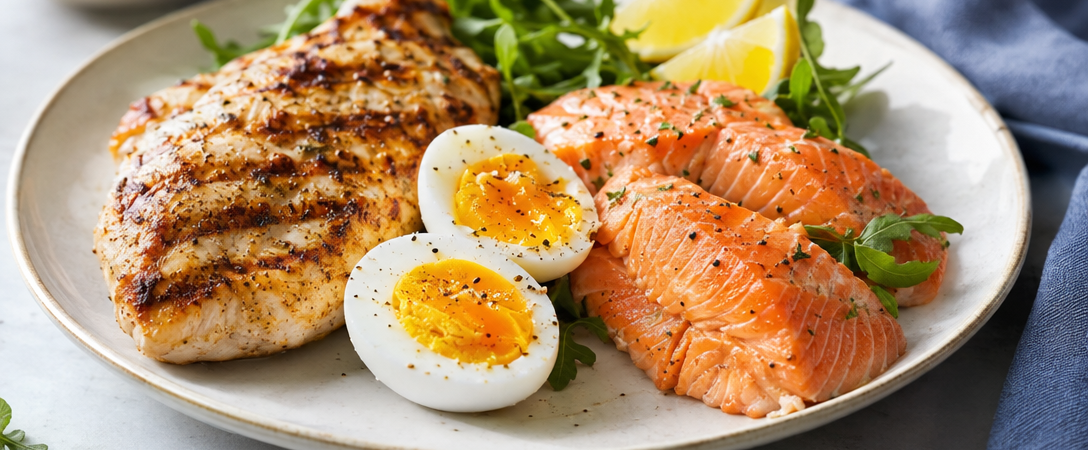
- Around 0.4 g of protein per kg of bodyweight per meal is a solid target for maximising muscle building, roughly 30 to 45 g for most people.
- The old idea that your body can only “use” 20 to 30 g of protein at once is a myth; extra protein is not wasted.
- Spreading protein across three to five meals has a small but real advantage over one or two big feedings.
- Total daily protein still matters most. Per-meal distribution is fine-tuning on top of a good daily total.
- Leucine, an amino acid rich in animal proteins, is a key trigger for the muscle-building signal at each meal.
To build muscle, aim for roughly 0.4 g of protein per kg of bodyweight per meal, which lands around 30 to 45 g for most people. That dose reliably maximises the muscle-building signal, called muscle protein synthesis, at each sitting. Getting your protein per meal right is a useful piece of the puzzle, but it sits on top of the bigger rule: hit a sufficient total daily protein first, then distribute it sensibly across your meals.
The per-meal target, and where it comes from
Each meal that contains enough protein triggers a rise in muscle protein synthesis, the process that builds new muscle tissue. Research points to roughly 0.4 g per kg of bodyweight as the dose that reliably maximises that response for most people. For an 80 kg lifter, that is about 32 g; for a 100 kg lifter, around 40 g. Older or more experienced trainees may sit slightly higher.
| Bodyweight | Protein per meal (~0.4 g/kg) |
|---|---|
| 60 kg | ~24 g |
| 75 kg | ~30 g |
| 90 kg | ~36 g |
| 105 kg | ~42 g |
Hitting this at three to four meals gets most people to a strong daily total. For the daily side of the equation, see our protein guide.
The “you can only absorb 30 g” myth
This one refuses to die, so let us be clear: your body absorbs almost all the protein you eat. It does not hit a wall at 30 g and flush the rest away. What is true is subtler: a single large dose does not stimulate muscle protein synthesis much more than a moderate dose, so the muscle-building signal has a ceiling per meal. The excess protein is still digested and used for other jobs, from tissue repair to being burned for energy, and it contributes to satiety. So a 60 g protein meal is not wasted; it simply does not double the building signal compared with 40 g. This matters for people eating fewer, larger meals, they are not throwing protein away.
Why spreading protein helps a little
Because each feeding maximises the signal up to a point, spreading your protein across three to five meals lets you trigger that response several times a day rather than once or twice. The advantage is real but modest. If your day looks like a tiny breakfast, a light lunch, and one enormous protein dinner, you are leaving a little muscle on the table compared with an even spread.
- Ideal: three to five meals, each hitting your per-meal target.
- Fine: two solid protein meals if life demands it, especially when the daily total is high.
- Sub-optimal: almost all your protein crammed into one meal.
A pre-sleep protein feeding, such as a casein-rich food, can be a useful way to add one more distributed dose overnight. Our notes on high-protein meals make hitting several feedings straightforward.
The role of leucine
Not all protein triggers the building signal equally. Leucine, one of the essential amino acids, acts as a key on-switch for muscle protein synthesis, and you need a certain amount per meal to flip it fully. Animal proteins, dairy, eggs, meat, fish, and whey, are naturally rich in leucine, which is why the per-meal targets are easy to hit with them. Plant proteins tend to be lower in leucine, so plant-based eaters benefit from slightly larger portions or combining sources to reach the same threshold. This is not a reason to avoid plants; it is a reason to be a little more deliberate with portions.
Keep it in proportion
Per-meal targets are the finishing touch, not the foundation. If you are new to this, do not obsess over grams at each meal before you have nailed your daily total and your training. Get enough protein overall, spread it across a few meals, aim for that 0.4 g per kg per sitting, and you have captured essentially all the benefit distribution can offer.
Frequently asked questions
How much protein per meal do you need to build muscle?
Aim for roughly 0.4 g of protein per kg of bodyweight per meal, which is about 30 to 45 g for most people. That dose reliably maximises the muscle-building signal at each sitting. Hit this target at three to four meals across the day to reach a strong daily total. Older and more experienced lifters may benefit from the higher end of that range.
Can your body only use 30 g of protein at once?
No, that is a myth. Your body absorbs nearly all the protein you eat; it does not discard the excess above 30 g. What plateaus is the muscle-building signal, which does not rise much beyond a moderate dose per meal. The extra protein is still used for other functions and adds fullness, so larger protein meals are not wasted, just not doubly anabolic.
Is it better to eat protein in many small meals?
Spreading protein across three to five meals has a small advantage over one or two, because each adequate feeding triggers the building signal afresh. The effect is modest, though. Your total daily protein matters far more than the exact number of meals. If your schedule only allows two or three protein feedings, prioritise hitting your daily target over chasing a perfect spread.
Do plant proteins need bigger portions per meal?
Often, yes. Plant proteins tend to be lower in leucine, the amino acid that switches on muscle building, so slightly larger servings or combining sources helps reach the per-meal threshold. This is easy to manage with beans, tofu, soya, and a protein supplement. It is not a barrier to building muscle on plants, just a reason to be a little more deliberate with portions.
The bottom line
Target around 0.4 g per kg of protein per meal, spread it across three to five feedings, and lean on leucine-rich sources to flip the muscle-building switch each time. Nail your daily total first, then let per-meal distribution add the finishing polish. Zerxus keeps your training progressing so that protein turns into real muscle. Build your plan at Zerxus.
Get the next one in your inbox.
Practical insights — no fluff, straight to your inbox.

Zerxus Coaching Team
Certified Strength & Conditioning Coaches
The Zerxus coaching team combines qualified personal trainers, certified strength coaches, and evidence-based sports science to build programmes that actually work. Every article is grounded in peer-reviewed research and practical coaching experience — no fads, no shortcuts.