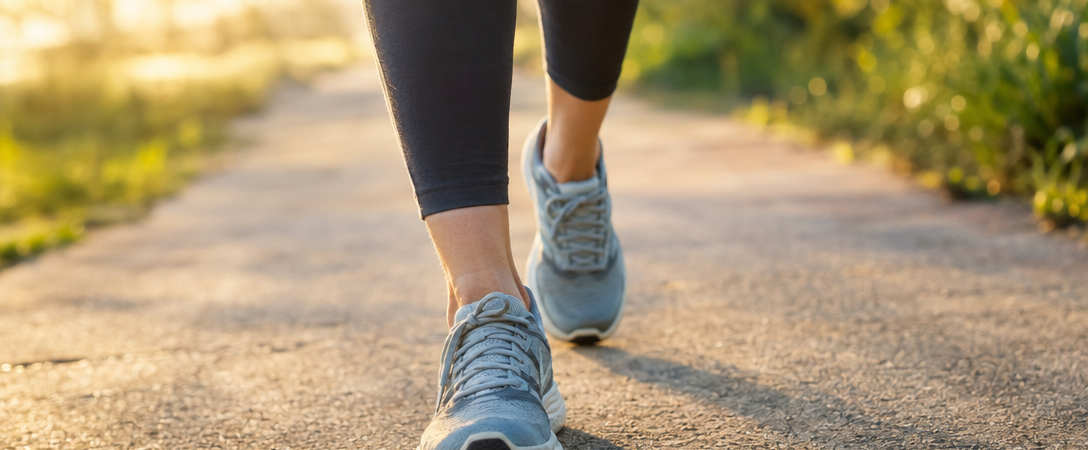
- There is no magic step number. For most people, somewhere between 8,000 and 12,000 steps a day supports fat loss without wrecking recovery.
- Walking helps because it widens your calorie deficit quietly, without the appetite spike and fatigue that hard cardio can bring.
- Your current baseline matters more than a round target. Add roughly 2,000 to 3,000 steps to whatever you already do and build from there.
- Steps only move the needle alongside a real calorie deficit and enough protein. Walking cannot outrun a surplus.
- Consistency across the week beats one heroic 20,000-step day followed by three days on the sofa.
For most people, the honest answer for steps per day for fat loss is somewhere between 8,000 and 12,000, adjusted to your own baseline rather than a number off a poster. Steps work because they widen your energy deficit gently: you burn a few hundred extra calories without triggering the hunger and fatigue that harder training often brings. Pair that habit with a genuine calorie deficit and enough protein, and walking becomes one of the most reliable fat-loss tools you have.
Why steps beat extra cardio for most people
Walking sits in a useful sweet spot. It burns meaningful energy over the day, yet it is easy enough that it barely dents your recovery for lifting. That matters, because the goal during a diet is to hold onto muscle while fat comes off. Long, punishing cardio sessions can eat into the recovery you need for hard training and often leave you hungrier and more tired, which quietly undoes the deficit you created.
Steps also scale with real life. You can accumulate them on a phone call, on the school run, or on a lunchtime loop. That flexibility is exactly why they stick. If you want the wider picture of how a deficit actually drives fat loss, our guide to the science of fat loss lays out the mechanics.
How to set your own step target
Forget the 10,000 figure for a moment; it came from a marketing campaign, not a lab. The smarter move is to measure your current average for a week, then add to it.
- Find your baseline. Wear your phone or watch for seven ordinary days and note the average. Many desk-bound people sit around 3,000 to 5,000.
- Add 2,000 to 3,000. A jump from 4,000 to 7,000 is far more sustainable than leaping to 15,000 and burning out in a week.
- Hold it for two to three weeks. Let the new number feel normal before you push higher.
- Nudge up if fat loss stalls. Adding another 2,000 steps is often easier and kinder to recovery than cutting calories further.
The rough energy cost of walking is often quoted as around 40 to 50 calories per 1,000 steps for an average adult, though it varies with bodyweight and pace. Over a week, an extra 5,000 steps a day can add up to a useful few hundred calories daily without any structured cardio at all.
Where people get it wrong
The commonest myth is that steps alone melt fat. They do not. If your diet drifts into maintenance, you can walk 15,000 steps a day and see nothing on the scale. Walking is the assistant to your deficit, not a substitute for it. Keep protein high to protect muscle, ideally in the region of 1.6 to 2.2 g per kg, as covered in our protein guide.
The second mistake is the weekend hero routine: 20,000 steps on Saturday, then almost nothing until the following weekend. Fat loss responds to the weekly average, so a steady 9,000 every day beats a wild swing. The third is treating steps as licence to eat back everything you burned. A post-walk pastry can erase the entire session in ninety seconds.
Steps versus structured cardio
Both have a place. Steps are low-cost and easy to recover from, so they should be your default lever. Structured work like zone 2 cardio is useful when you want to build a genuine aerobic base or you are short on time and want more burn per minute. During a fat-loss phase, we usually suggest steps first, then a little zone 2, and only then any harder conditioning, in that order of priority.
Making the habit stick
The best step target is the one you actually hit. A few tactics that hold up well: walk after meals to blunt the post-eating slump, take calls on your feet, park further away on purpose, and treat a short evening loop as a fixed appointment rather than an optional extra. If you struggle to keep any training habit going, our notes on staying consistent with training apply just as well to walking. Small, boring repetition is what wins here.
Frequently asked questions
How many steps a day should you walk to lose fat?
Most people do well between 8,000 and 12,000 steps a day, but the right figure is personal. Measure your current average, add 2,000 to 3,000, and hold that for a few weeks before pushing higher. Steps support fat loss by widening your calorie deficit, so they only work when your overall diet is already in a deficit.
Is 10,000 steps a day necessary?
No. The 10,000 figure came from a marketing slogan, not research. Plenty of people lose fat well on 8,000, and some need more. What matters is that your daily steps are meaningfully above your baseline and that you hit a similar number most days rather than chasing one big total occasionally.
Can I lose fat by walking alone?
Walking helps, but only within a calorie deficit. If your food intake matches or exceeds what you burn, walking will not shift fat no matter how far you go. Use steps to widen your deficit and protect recovery, while your diet does the heavy lifting and hard training preserves your muscle.
Do steps count if they are slow?
Yes. A slower walk burns slightly fewer calories per step, but the difference is small and the total volume still counts. For fat loss, accumulating more steps at any easy pace beats forcing a fast walk you will not repeat tomorrow. Comfortable and repeatable wins over intense and occasional.
The bottom line
Steps are the quiet workhorse of fat loss: cheap, easy to recover from, and simple to build into a normal day. Find your baseline, add a couple of thousand, keep protein high, and stay in a deficit. Zerxus keeps your lifting progressing while you diet, so the fat comes off and the muscle stays. Build your plan at Zerxus.
Get the next one in your inbox.
Practical insights — no fluff, straight to your inbox.
Zerxus Coaching Team
Certified Strength & Conditioning Coaches
The Zerxus coaching team combines qualified personal trainers, certified strength coaches, and evidence-based sports science to build programmes that actually work. Every article is grounded in peer-reviewed research and practical coaching experience — no fads, no shortcuts.