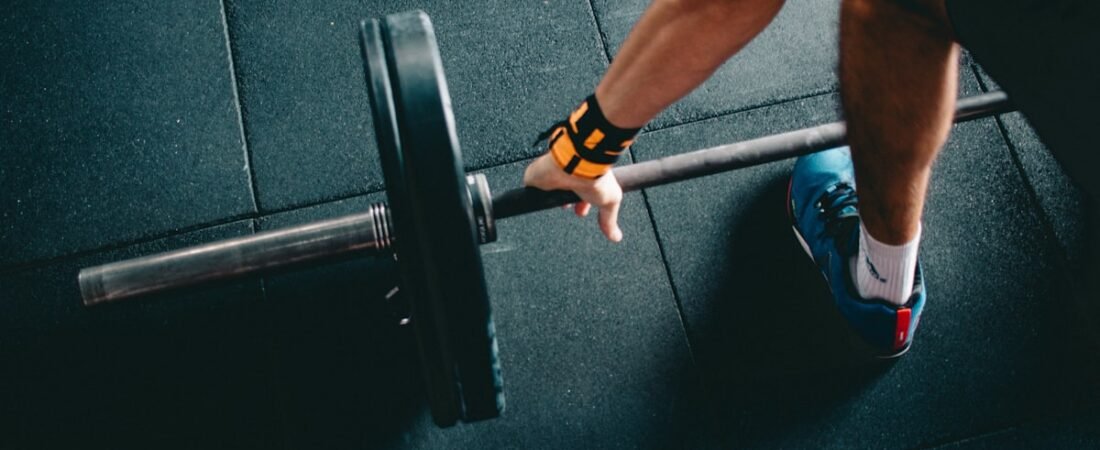
- The Romanian deadlift keeps constant tension on the hamstrings and glutes because the bar never rests on the floor.
- The movement is a hip hinge, not a squat: push the hips back and keep the knee angle roughly constant.
- Lower only until you feel a strong hamstring stretch, usually just below the knee, with a neutral spine throughout.
- Start light to groove the pattern, then progress load gradually once you can feel the target muscles working.
- Train it once or twice a week as an accessory, using 8-12 reps for size and 4-6 reps for strength.
The Romanian deadlift, or RDL, is a hip-hinge exercise where you lower a loaded barbell down the front of your legs by pushing your hips back, then drive them forward to stand. Because the bar never touches the floor, tension stays on the hamstrings and glutes for the whole set, which makes it one of the best posterior-chain builders you can add to a programme.
What makes the Romanian deadlift different
A conventional deadlift starts from the floor and resets on every rep, sharing the load across the quads, back and hips. The RDL starts from standing and stays in the air, so the hamstrings and glutes carry the work through a long, controlled range. That constant tension is why we reach for it when we want the back of the legs to grow rather than a bigger floor pull.
The pattern itself is a hip hinge: the hips travel backwards while the torso folds forward, and the knees stay softly bent without turning the lift into a squat. If the hinge feels unfamiliar, our hip hinge guide breaks it down before you load a bar. The RDL also pairs neatly with the conventional deadlift as a way to strengthen the top half of the pull.
Muscles the RDL trains
- Hamstrings: the primary mover, loaded under a deep stretch on every rep.
- Glutes: drive the hips forward to finish each rep at the top.
- Erector spinae: hold the spine neutral against the folding torso.
- Traps and lats: keep the bar tight to the body and stop it drifting away.
- Core: braced throughout to protect the lower back under load.
Because the glutes finish the movement, the RDL complements dedicated glute work such as the hip thrust, giving you two angles on the same muscles.
Step-by-step technique
Set up standing hip-width apart with a double-overhand grip on the bar. Pull your shoulders down and think about bending the bar around your legs to switch the lats on. Keep a slight, fixed bend in the knees.
Begin by pushing your hips back, not down. Imagine reaching your backside towards a wall behind you while the bar slides down your thighs, staying in contact with the legs the whole way. Lower until you feel a firm stretch in the hamstrings, which lands just below the knee for most people. If your lower back starts to round, you have gone past your current range and should stop earlier.
To stand back up, squeeze the glutes and drive the hips forward until you are tall, without leaning back or over-arching at the top. A neutral, stacked position is all you need. Control the descent every time rather than dropping into the stretch.
Common mistakes we see
| Mistake | Fix |
|---|---|
| Rounding the lower back | Reduce the load and keep a neutral spine; stop the rep where control ends. |
| Bending the knees too much | Hold the knee angle steady so the hips, not the knees, create the movement. |
| Bar drifting forward | Drag the bar along the legs to keep the load close and spare the lower back. |
| Chasing heavy weight early | Prioritise the hamstring stretch over the number on the bar. |
One myth worth clearing up: the RDL is not meant to be a max-effort floor deadlift done from the top. Loading it as heavily as your conventional pull usually wrecks position and turns a hamstring exercise into a lower-back grind. The point is quality tension, not a personal best.
How to programme the RDL
We suggest training the RDL once or twice a week, placed after your main squat or deadlift as an accessory. A simple structure works well:
- 3-4 sets of 8-12 reps for size and hamstring development.
- 3-5 sets of 4-6 reps when you want to bias strength.
- Add a single, small load increase only once every rep feels controlled through the full range.
This steady climb is the practical face of progressive overload: more quality reps or a touch more weight over time, never a jump so big that form collapses.
Frequently asked questions
How is the RDL different from a conventional deadlift?
The RDL starts from standing and the bar never touches the floor, which keeps the hamstrings and glutes under constant tension. A conventional deadlift starts from the ground, resets each rep, and shares more of the work with the quads and lower back. Think of the RDL as a targeted posterior-chain builder rather than a maximal full-body pull.
Can beginners do Romanian deadlifts?
Yes. Beginners often learn the pattern fastest with light dumbbells or an empty barbell, which lets you feel the hip hinge before adding load. Groove the movement first, keep the spine neutral, and only add weight once you can reach a hamstring stretch without your back rounding. Technique should always come before load.
How much weight should I use for RDLs?
Start with a load you can control for 10-12 clean reps while still feeling the hamstrings work. For many lifters that lands somewhere near 40-60% of their conventional deadlift, though the right number is simply the one that keeps your form and stretch intact. Increase gradually once the movement feels solid.
Should I feel RDLs in my lower back?
You should mainly feel the hamstrings and glutes, with some mild erector fatigue as they stabilise your spine. Sharp or dominant lower-back pain is a warning sign, usually from rounding, letting the bar drift away, or using too much weight. Reset your position, lighten the load, and the sensation should move back to the hamstrings.
Build your RDL into a plan that fits you
The Romanian deadlift rewards patience: master the hinge, keep tension where it belongs, and let load follow technique. If you want that dialled into a programme built around your goals, equipment and recovery, we combine AI precision with human coaching at Zerxus.
Get the next one in your inbox.
Practical insights — no fluff, straight to your inbox.
Zerxus Coaching Team
Certified Strength & Conditioning Coaches
The Zerxus coaching team combines qualified personal trainers, certified strength coaches, and evidence-based sports science to build programmes that actually work. Every article is grounded in peer-reviewed research and practical coaching experience — no fads, no shortcuts.